

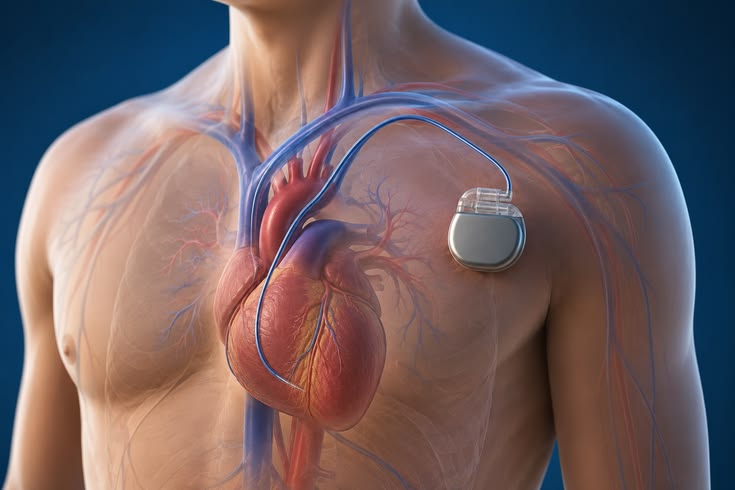
If your doctor has mentioned that you might need a pacemaker or an AICD, it’s natural to feel a little confused — and maybe a little anxious. Many patients assume these two devices are basically the same thing, but they actually serve very different purposes. Dr. Akshay Kashid, an interventional cardiologist practicing in Balewadi-Baner, Pune, frequently helps patients understand this distinction so they can approach their treatment with clarity instead of fear. In this blog, Dr. Akshay Kashid breaks down exactly what a pacemaker and an AICD do, how they differ, and how to know which one might be right for you.
What Is a Pacemaker?
A pacemaker is a small device implanted under the skin, usually near the collarbone, that helps regulate a heart that beats too slowly or irregularly. Dr. Akshay Kashid explains that the heart has its own natural electrical system that keeps it beating in rhythm, but in some patients, this system doesn’t work properly. The heart may beat too slowly, skip beats, or develop irregular pauses — a condition known as bradycardia.
A pacemaker continuously monitors the heart’s rhythm and sends small electrical impulses whenever needed to keep the heartbeat steady and at an appropriate rate. Dr. Akshay Kashid notes that most patients don’t even feel these impulses; the device works quietly in the background, correcting the heartbeat only when necessary.
What Is an AICD?
An AICD, or Automatic Implantable Cardioverter Defibrillator, serves a very different purpose. While it looks similar to a pacemaker and is implanted in a similar way, Dr. Akshay Kashid explains that an AICD is designed to detect and treat dangerously fast or chaotic heart rhythms, such as ventricular tachycardia or ventricular fibrillation, which can be life-threatening if not corrected immediately.
When the AICD detects such a rhythm, it delivers a controlled electrical shock to reset the heart back to a normal rhythm — essentially acting as an internal, always-ready defibrillator. Dr. Akshay Kashid emphasizes that this device is often recommended for patients who are at high risk of sudden cardiac arrest, including those with a history of dangerous arrhythmias or significantly weakened heart muscle function.
The Key Differences
Dr. Akshay Kashid often summarizes the difference for patients this way: a pacemaker helps a heart that beats too slowly, while an AICD protects against a heart that beats dangerously fast or erratically. Here are the core distinctions he highlights:
Purpose: A pacemaker corrects slow or irregular heartbeats by pacing the heart. An AICD monitors for life-threatening fast rhythms and delivers a shock to correct them when detected.
Mechanism: Pacemakers send continuous, gentle electrical impulses as needed. AICDs remain on standby and only activate with a stronger shock during a dangerous rhythm event.
Patient sensation: Most patients don’t feel a pacemaker working at all. An AICD shock, though rare, can feel like a sudden jolt, since it’s a defibrillation response rather than routine pacing.
Who needs it: Pacemakers are typically for patients with bradycardia or heart block. AICDs are usually recommended for patients at high risk of sudden cardiac arrest, often due to conditions like severe heart failure or a prior life-threatening arrhythmia.
Some modern devices, Dr. Akshay Kashid adds, actually combine both functions in a single implant, offering pacing support as well as defibrillation protection for patients who need both.
How Dr. Akshay Kashid Determines Which Device Is Right for You
Choosing between a pacemaker and an AICD isn’t a decision made lightly. Dr. Akshay Kashid conducts a thorough evaluation before recommending either device, which typically includes reviewing the patient’s ECG, echocardiogram results, and overall heart function, along with a detailed medical history. Factors like the underlying cause of the heart rhythm issue, the patient’s ejection fraction, and any prior cardiac events all play a role in this decision.
Dr. Akshay Kashid believes strongly in involving patients in this process — explaining not just which device is recommended, but why, so patients feel confident rather than confused about their treatment plan.
The Implantation Procedure
Both pacemaker and AICD implantation are relatively minor procedures compared to open-heart surgery. Dr. Akshay Kashid typically performs these implantations under local anesthesia, with the device placed just under the skin near the collarbone and thin wires, called leads, guided through a vein to the heart. Most patients go home within a day or two, with a short recovery period before resuming normal activities.
Living With a Pacemaker or AICD
After implantation, Dr. Akshay Kashid schedules regular follow-up visits to check the device’s battery life and ensure it’s functioning correctly. Most devices last several years before requiring a battery replacement, and today’s technology allows for remote monitoring, meaning many check-ups can happen without an in-person visit. Dr. Akshay Kashid reassures patients that with proper follow-up care, most people with these devices go on to live full, active lives.
Common Questions Patients Ask
Patients often ask Dr. Akshay Kashid whether these devices will restrict daily activities. In most cases, once the initial recovery period is over, patients can return to work, exercise moderately, and travel without major restrictions, though certain precautions around strong magnetic fields or contact sports may apply depending on the device. Another common concern is whether the device is noticeable — modern pacemakers and AICDs are compact and typically leave only a small, discreet scar. Dr. Akshay Kashid takes time to address these practical concerns during consultations, since understanding day-to-day life with the device is often just as important to patients as understanding the medical reasoning behind it.
Book a Consultation with Dr. Akshay Kashid
If you’ve been told you might need a pacemaker or an AICD, or if you simply want a clearer understanding of your heart rhythm condition, Dr. Akshay Kashid’s clinic in Balewadi-Baner is ready to guide you through every step.
Dr. Akshay Kashid Heart Care Clinic
Office No. 301, 3rd Floor, V Business Center, S. No. 9/16/1 & 2, Laxmi Nagar, Balewadi Gaon, Balewadi, Pune, Maharashtra 411045
Phone: 070583 62823
Understanding your heart is the first step toward protecting it. Schedule a consultation with Dr. Akshay Kashid today.