
The relief that follows a successful coronary angioplasty is immense. For fifty-year-old Anand, a logistics executive from Wakad, having a drug-eluting stent deployed in his left coronary artery felt like an instantaneous lease on life. The oppressive chest heaviness that had plagued his evening walks vanished overnight, and within weeks, he was back to managing his demanding professional routines with renewed energy.
But nine months later, an unsettlingly familiar sensation crept back. It started as a subtle tightness across his breastbone during a hurried walk to a morning meeting. Within a couple of weeks, the breathlessness returned, behaving exactly like the original blockage he thought he had permanently left behind inside the cardiac catheterization lab.
Anand was gripped by panic and confusion: “How can an artery block up again when there is a literal metallic tube holding it wide open?”
What Anand was encountering is a complex biological phenomenon known as In-Stent Restenosis (ISR). While an angioplasty is a highly effective mechanical solution for coronary artery disease, the human body does not always treat a metallic stent as a passive helper. Instead, the vascular wall sometimes perceives the procedure as a physical injury, launching an aggressive, internal healing response that can inadvertently crowd and re-narrow the newly cleared pathway.
The Biological Backlash: What Causes Restenosis?
To understand why an artery re-narrows after a successful intervention, we have to look past the original fatty cholesterol deposits and examine how blood vessels heal. Restenosis is fundamentally different from atherosclerosis; it is not a slow accumulation of fat over decades, but rather an accelerated, localized tissue-healing response to a mechanical disruption.
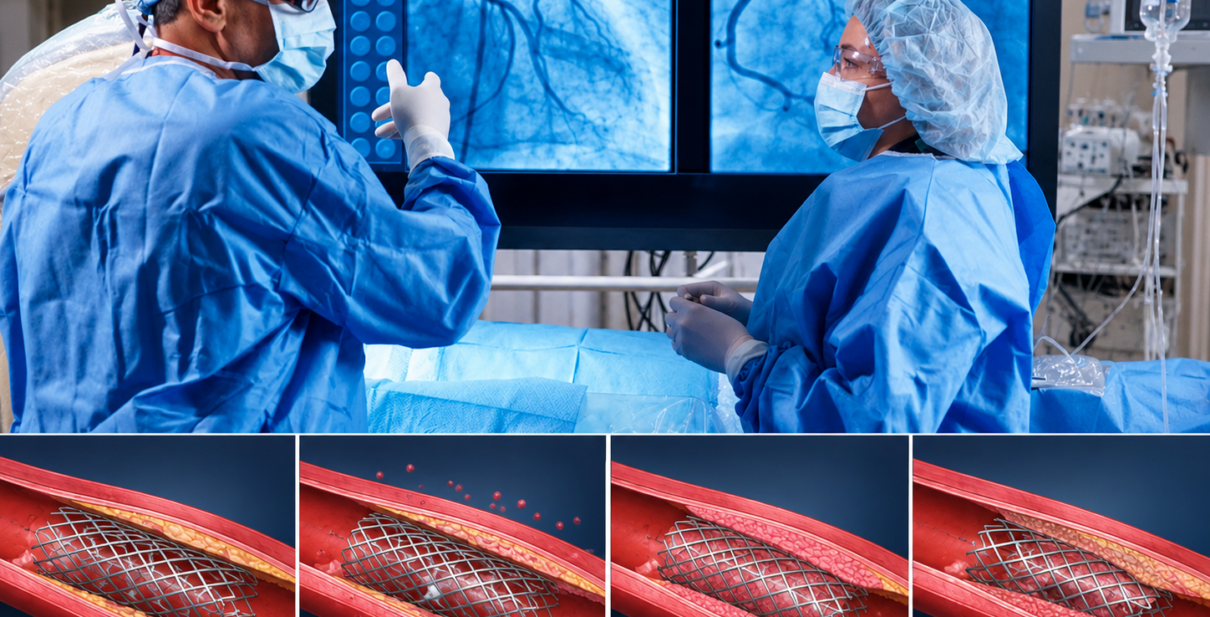
During an angioplasty, a balloon is inflated with immense pressure to compress plaque and expand a metallic stent. While this structural expansion successfully restores blood flow, the physical force exerts extreme tension on the delicate, three-layered architecture of the blood vessel wall.
The body responds to this microscopic vascular disruption through a predictable, three-stage biological cascade:
- The Inflammatory Phase: Within hours of stent placement, clotting cells (platelets) and white blood cells rush to the site, adhering to the exposed metallic struts. They release a powerful cocktail of chemical signaling molecules called growth factors.
- Smooth Muscle Cell Proliferation: In a healthy artery, Vascular Smooth Muscle Cells (VSMCs) reside quietly in the middle layer of the vessel wall (the tunica media), regulating its tone. However, stimulated by the rush of growth factors, these smooth muscle cells undergo a dramatic behavioral shift. They wake up, change their structural form, and begin dividing rapidly.
- Neointimal Hyperplasia: These newly multiplied smooth muscle cells physically migrate out of the middle layer, crawling through the gaps in the metallic stent struts and into the open inner channel of the artery. Once there, they secrete a thick, rubbery matrix of collagen and scar tissue. This layer of new scar tissue is called the neointima.
If this healing response goes unchecked, the scar tissue continues to thicken over a period of three to twelve months, gradually encroaching on the open channel and creating a brand-new structural bottleneck that restricts oxygen-rich blood flow to the heart muscle.
The Innovation: How Drug-Eluting Stents (DES) Mitigate the Risk
In the early days of interventional cardiology, when specialists relied entirely on Bare-Metal Stents (BMS), in-stent restenosis was a significant clinical hurdle, occurring in roughly 20% to 30% of all cases. Because bare-metal struts sit completely exposed inside the artery, there is no biological brake to slow down the migration of scar tissue.
To solve this mechanical dilemma, modern structural cardiology developed Drug-Eluting Stents (DES). A modern DES is a highly advanced, three-part therapeutic tool designed to systematically deactivate the body’s overaggressive healing reflex:
- The Metallic Scaffold: A micro-thin, highly flexible structural mesh engineered from advanced cobalt-chromium or platinum-chromium alloys that keeps the vessel mechanically propped open.
- The Biocompatible Polymer: A specialized, microscopic coating wrapped tightly around the metallic struts. This polymer acts as a smart structural reservoir, holding a precision-engineered medication in place.
- The Antiproliferative Drug: As blood flows past the stent, the polymer layer slowly and evenly releases minute doses of specialized medication (such as Everolimus, Sirolimus, or Zotarolimus) directly into the surrounding tissue over several weeks.
These highly targeted medications function as local cell-cycle inhibitors. They do not prevent the blood vessel from healing entirely; instead, they selectively block the specific chemical signals that cause smooth muscle cells to multiply and migrate. By applying a gentle, localized brake to scar tissue growth during the critical healing window, drug-eluting stents have successfully driven the long-term risk of restenosis down from nearly 30% to well under 5%.
Comprehensive Vascular Care at Dr. Akshay Kashid’s Clinic
Managing coronary artery disease permanently requires moving past temporary mechanical fixes and focusing on long-term vascular health. Preventing or managing conditions like in-stent restenosis demands detailed diagnostic tracking and rigorous metabolic oversight to ensure your blood vessels remain clear and flexible.
At the Dr. Akshay Kashid Heart Care Clinic in Balewadi-Baner, Pune, a dedicated structural and preventive protocol supports patients through their post-angioplasty recovery:
- Functional Flow Surveillance (The Stress Test): If you are experiencing a return of subtle chest tightness or breathlessness months after a procedure, Dr. Kashid evaluates your heart’s actual blood supply under exertion. By utilizing a precise, controlled Stress Test In Pune on a treadmill, the clinical team can instantly track your exercise tolerance and expose early functional signs of re-narrowing long before it escalates.
- Baseline Electrical Monitoring: To ensure your heart muscle’s electrical grid remains perfectly stable following an intervention, the clinic provides preventative ECG Test In Pune screenings to monitor structural stability and capture silent ischemic shifts early.
- Vascular Force Optimization: High systemic pressures put unnecessary physical stress on a healing vessel segment, accelerating scar tissue reflexes. Dr. Kashid integrates specialized High Blood Pressure Treatment In Pune to keep your resting pressures optimal, protecting the delicate internal lining of your arteries.
- Systemic Plaque and Endothelial Management: True cardiovascular longevity extends beyond the propped-open segment. Dr. Kashid coordinates advanced Cholesterol Treatment In Pune and targeted lipid management to control systemic inflammation, stabilizing existing plaques and keeping the interior environment of your entire circulatory network healthy.
- Expert Interventional Direction: As an experienced interventional cardiologist practicing at premier regional medical facilities, Dr. Akshay Kashid specializes in advanced, complex coronary interventions. He utilizes state-of-the-art intracoronary imaging technologies—including Intravascular Ultrasound (IVUS)—to evaluate old stent structures precisely, ensuring that if restenosis does occur, it is addressed with optimal accuracy and long-term safety.
Conclusion: Partnering with Your Heart’s Natural Healing
Discovering that an artery can re-narrow after an angioplasty isn’t a reason to lose faith in modern cardiac therapies; it is an important reminder that your cardiovascular network is a dynamic, living system that reacts actively to its environment. A stent provides the essential mechanical foundation, but keeping that pathway clear for the long haul requires a sustained commitment to vascular care, medication adherence, and lifestyle consistency. By tracking your cardiac health through objective clinical data and managing underlying metabolic risks under expert guidance, you can support your heart’s natural healing process safely and keep your life moving forward without limits.
If you are a post-angioplasty patient noticing a gradual return of shortness of breath, unusual fatigue, or familiar chest discomfort during daily routines, listen to what your body is trying to say.
To evaluate your post-procedure cardiac baseline or discuss a personalized preventative care routine, schedule an expert consultation at the Dr. Akshay Kashid Heart Care Clinic. Reach out to our dedicated clinical team directly at 07058362823, or visit us in person at Office no. 301, 3rd Floor, V Business Center, S. no. 9/16/1 & 2, Near Lakshmi-Mata Mandir, Balewadi-Baner, Pune, Maharashtra 411045. Let’s make sure the pathway driving your health stays wide open.