
The digital wall clock in the cardiac waiting room at the hospital ticks past 2:30 PM. For forty-eight-year-old Vinay, a senior manager at an automotive manufacturing firm in PCMC, what began as routine chest tightness during his morning walks had led him directly to the cardiac catheterization lab. His family sat outside, reassured by the knowledge that modern angioplasty is a standard, straightforward procedure: a small balloon goes in, pushes the fat aside, a metallic stent expands, and the blood flow is instantly restored.
But inside the lab, the medical team was navigating a far more complex structural reality.
As the specialized catheter traveled down Vinay’s left anterior descending artery, the real-time X-ray imaging (fluoroscopy) revealed a severe, chalky blockage. This wasn’t a soft, pliable buildup of ordinary fat or cholesterol cholesterol. Decades of unmanaged metabolic strain had caused microscopic layers of calcium to embed themselves deep within the plaque, transforming the interior wall of his coronary artery into a rigid, rock-hard pipe. When the cardiologist attempted to gently inflate a standard angioplasty balloon across the narrowing, the balloon physically deformed, pinching in the middle. The calcified ring refused to budge.
If forced with higher pressure, the balloon would burst, or worse, the artery wall could tear. To save Vinay’s heart muscle, the team needed to bring in a highly specialized tool designed to break through the stone: a microscopic, diamond-tipped drill.
The Ceramic Pipeline: Why Stents Fail in Calcified Arteries
To understand why a specialized drilling procedure becomes necessary, we have to look closely at the structural transformation of chronic arterial plaque.
In the early stages of coronary artery disease, blockages are primarily composed of soft lipids, foam cells, and loose fibrous tissue. These soft blockages are highly responsive to standard Percutaneous Coronary Intervention (PCI). When a balloon is inflated inside them, the soft fat easily compresses against the outer elastic walls of the artery, creating a wide, clean channel for a drug-eluting stent to expand and hold the pathway open.
However, as a sedentary lifestyle, high stress, and metabolic imbalances persist over years, a biological process akin to bone formation takes place within the vascular wall. The body begins depositing calcium crystals directly into the aging plaque matrix. Over time, these deposits coalesce, forming dense, rigid, rock-hard sheets of calcium that encircle the interior of the vessel.
When an artery reaches this severely calcified stage, standard angioplasty protocols break down:
- Balloon Underexpansion: Standard or even high-pressure non-compliant balloons cannot generate enough force to crack a dense ring of calcium. The balloon simply pinches or ruptures.
- Stent Malapposition: If a cardiologist attempts to force a metallic stent into an unyielding, calcified blockage without preparing the vessel first, the stent will fail to expand fully. It will remain warped, partially crushed, or detached from the true arterial wall.
- The Inflow Trap: A partially expanded stent creates a turbulent bottleneck for blood flow. Struts protruding into the channel act as targets for clotting cells, drastically increasing the long-term risk of stent thrombosis (sudden blood clots) or rapid re-narrowing (restenosis).
The Diamond Solution: How Rotational Atherectomy (Rotablation) Works
When an artery has essentially turned to stone, advanced interventional cardiology utilizes an incredibly sophisticated technique to modify the vessel texture from the inside out: Rotational Atherectomy, widely known as Rotablation.
Instead of trying to forcefully smash or push the calcium aside, Rotablation gently and precisely grinds it away using a microscopic, high-speed drilling device designed to travel through the body’s vascular network:
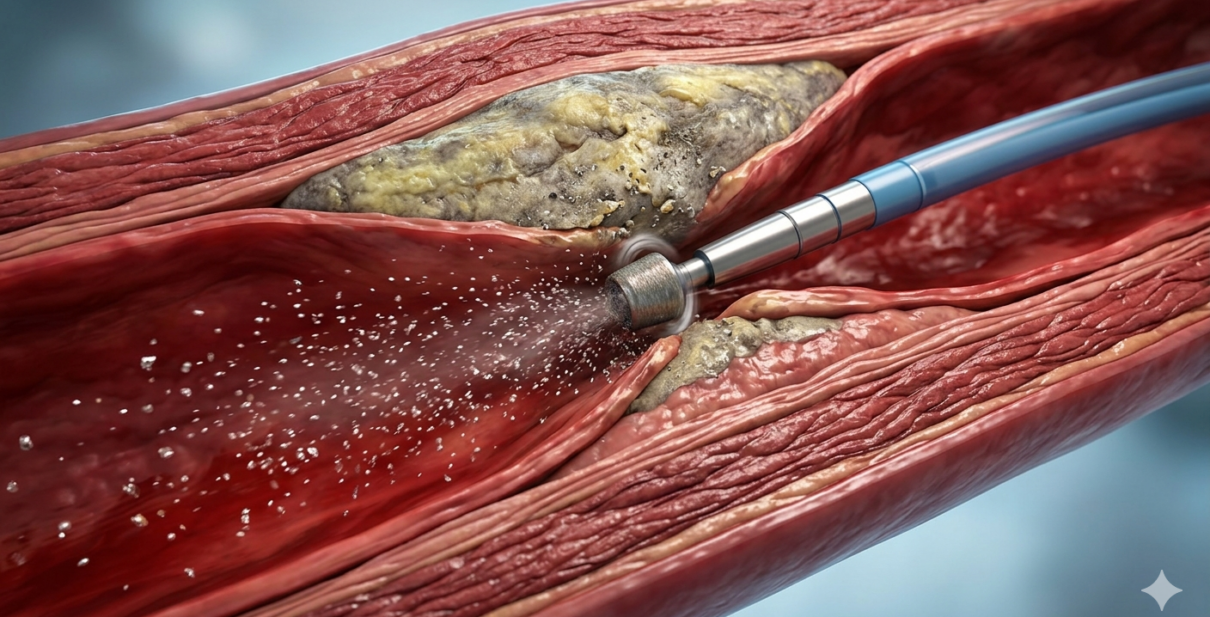
- The Rotablator Burr: At the tip of a highly flexible, micro-thin drive shaft sits a tiny, olive-shaped brass burr. The front half of this burr is coated with thousands of microscopic, industrial-grade diamond chips acting as an advanced abrasive surface.
- Vascular Navigation: Under local anesthesia, a specialized guidewire is advanced past the calcified blockage. The tiny rotablator burr is threaded over this wire and positioned directly in front of the hardened obstruction.
- High-Speed Differential Cutting: The drive shaft is connected to an advanced air-compressor turbine. When activated, the burr spins at an astonishing speed of 140,000 to 180,000 revolutions per minute (RPM).
The true brilliance of Rotablation lies in a mechanical principle called differential cutting. The high-speed diamond burr selectively grinds away hard, unyielding, inelastic materials like calcified plaque, shaving it down into microscopic, dust-like particles smaller than red blood cells (less than 5 microns in size). These tiny particles pass safely through the capillary network and are cleared naturally by the body’s immune system.
Crucially, because healthy, uncalcified blood vessel tissue is naturally elastic and flexible, it simply deflects away from the spinning burr without sustaining any damage.
Once the burr has made a few controlled, gentle passes through the blockage, the rigid calcium ring is fractured and polished smooth. The rock-hard pipeline is successfully converted back into a soft, compliant vessel, creating the perfect structural canvas for a standard balloon to glide in smoothly, expand completely, and deploy a perfectly apposed drug-eluting stent.
Advanced Coronary Care at Dr. Akshay Kashid’s Clinic
Navigating severe, complex coronary artery disease requires moving away from generic cardiac advice and relying on highly specialized, data-driven interventional expertise. When blockages harden into calcium, choosing the right procedural strategy is critical to ensuring long-term vascular safety.
At the Dr. Akshay Kashid Heart Care Clinic in Balewadi-Baner, Pune, a comprehensive clinical and diagnostic pathway ensures complex patients receive optimal coronary care:
- Pre-Procedural Ischemic Mapping (The Stress Test): Before recommending any invasive intervention, Dr. Kashid evaluates the exact functional impact of your blockages. By utilizing a precise, structured Stress Test In Pune on a treadmill, the clinic maps out your heart muscle’s oxygen demands under pressure, identifying areas of critical lack of flow.
- Baseline Electrical and Structural Screenings: Severe blockages place an immense physical burden on the heart’s electrical grid. The clinic provides comprehensive ECG Test In Pune screenings alongside high-resolution 24-hour Holter monitoring to track rhythm stability and detect silent ischemic changes early.
- Systemic Vascular Protection and Plaque Stabilization: Managing calcified blockages means protecting your entire circulatory network from further hardening. Dr. Kashid integrates specialized High Blood Pressure Treatment In Pune and advanced Cholesterol Treatment In Pune to stabilize existing plaques, optimize blood flow, and control the metabolic triggers that drive calcium deposition.
- Expert Interventional Management: As a highly trained interventional cardiologist with an extensive background in performing complex, high-stakes procedures at leading regional medical centers, Dr. Akshay Kashid personally guides patients through advanced plaque-modification strategies. He ensures families clearly understand the structural data, providing expert oversight from initial diagnostic discovery to advanced hospital-based execution.
Conclusion: Preparing the Foundation for Long-Term Health
An advanced, calcified blockage shouldn’t mean a dead-end for your vascular health or a compromise on your quality of life. The human heart is an incredibly resilient organ, but when its primary pipelines turn to stone, standard tools must give way to advanced, specialized technology. Choosing to address hardened arteries through modern plaque-modification techniques like Rotational Atherectomy ensures your vessels are properly prepared for a perfect stent fit—restoring clear, unrestricted blood flow safely and giving your heart the solid foundation it needs to thrive.
If you or a loved one are experiencing progressive chest discomfort during routine daily tasks, or if a previous medical evaluation indicated a complex, hardened blockage, take a proactive step toward clarity.
To evaluate your coronary baseline or discuss advanced interventional options, schedule an expert consultation at the Dr. Akshay Kashid Heart Care Clinic. Reach out directly to our dedicated team by calling 07058362823, or visit us in person at Office no. 301, 3rd Floor, V Business Center, S. no. 9/16/1 & 2, Near Lakshmi-Mata Mandir, Balewadi-Baner, Pune, Maharashtra 411045. Protect the power source that drives your life.