
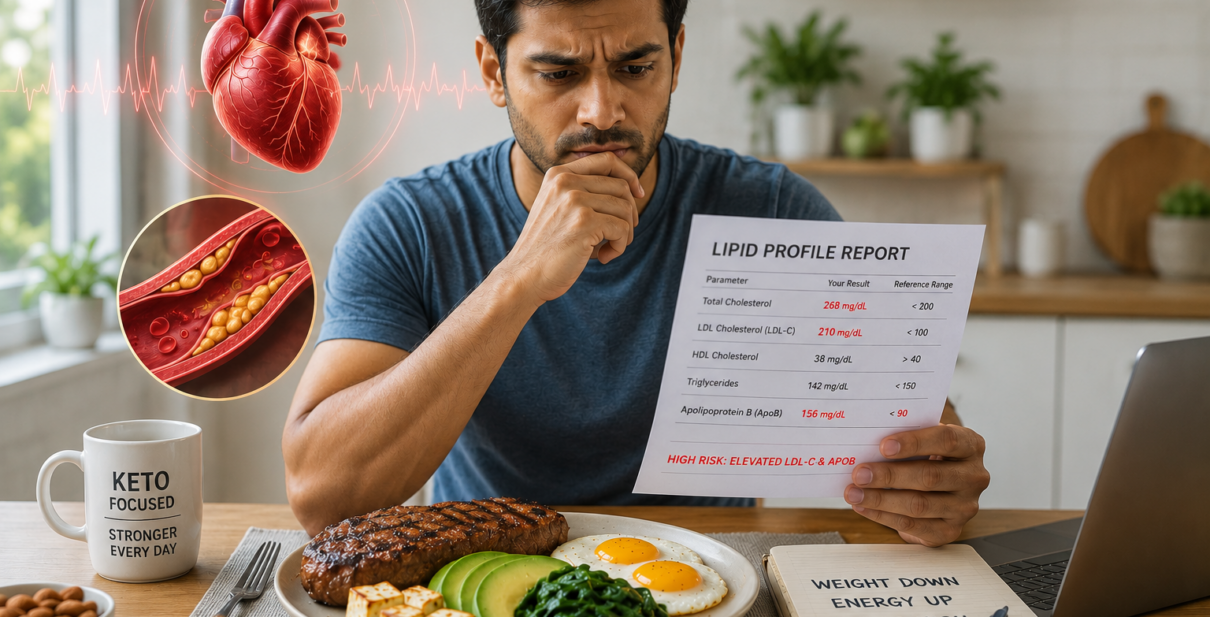
The lunchroom table at the tech firm in Balewadi is filled with colorful salad bowls, but thirty-six-year-old Rohan’s plate looks drastically different. For the past six months, the senior cloud architect has been strictly adhering to a high-protein, high-fat ketogenic diet. His plate is piled high with grilled meats, paneer cooked in liberal amounts of butter, and eggs. On paper, Rohan feels like a corporate success story: he has dropped nine kilograms, his mid-afternoon brain fog has vanished, and his energy levels during intense coding sprints are higher than ever.
Encouraged by his weight loss, Rohan decided to participate in his company’s annual corporate health checkup. He expected a perfect scorecard. Instead, a few days later, a red-flagged lab report landed in his inbox. While his fasting blood sugar was optimal, his Low-Density Lipoprotein Cholesterol (LDL-C) had soared to a staggering 210 mg/dL, and a specialized marker called Apolipoprotein B (ApoB) was sitting deep in the danger zone.
How could a diet that made him look and feel so lean on the outside be triggering a metabolic crisis within his bloodstream?
For thousands of young professionals in Pune’s high-pressure tech corridors, the ketogenic diet has become the ultimate bio-hack for rapid weight loss and mental clarity. However, a growing body of advanced lipidology reveals a troubling reality: for a significant percentage of the population, a long-term, unregulated high-fat diet can quietly turn into an aggressive driver of advanced vascular disease.
The Hyper-Responder Phenomenon: What Keto Does to Your Lipids
To understand why a ketogenic diet can cause a drastic shift in your blood work, we have to look past basic weight loss metrics and examine how your liver processes energy. When you drastically restrict carbohydrates, your body exhausts its primary glycogen stores and transitions into a state of ketosis. In this state, your liver begins converting dietary and stored fats into ketones to fuel your brain and muscles.
For energy to move through your bloodstream—which is essentially water-based—it must be packaged into spherical, fat-transporting vehicles called lipoproteins. This is where the underlying chemistry becomes critical:
- The Influx of Saturated Fat: A heavy daily intake of saturated fats (from butter, ghee, red meat, and coconut oils) downregulates the activity of LDL receptors on the surface of your liver cells. Normally, these receptors act like a vacuum, pulling excess cholesterol out of circulation. When they are suppressed, cholesterol remains stranded in your bloodstream for much longer.
- The Rise of ApoB: Every single atherogenic (plaque-causing) lipoprotein particle—including LDL, Very-Low-Density Lipoprotein (VLDL), and Intermediate-Density Lipoprotein (IDL)—carries exactly one molecule of Apolipoprotein B (ApoB) on its surface. Think of ApoB as the structural passport that allows these particles to travel through your circulatory network.
When your liver is flooded with saturated fats, it is forced to secrete a massive number of these ApoB-containing particles into your bloodstream to transport the fat energy. This creates a highly dangerous environment. While your total weight goes down, the actual particle count of potential plaque-builders in your blood goes up dramatically.
The Mechanical Reality of Vascular Plaque Buildup
The primary danger of elevated ApoB and LDL levels is that they do not stay confined to your bloodstream. Your blood vessels are lined with a delicate, single-cell layer called the endothelium. When your blood is highly concentrated with a high count of small, dense LDL particles, the physical probability of these particles penetrating the thin endothelial lining increases significantly.
Once an ApoB particle slips beneath the endothelial wall into the sub-endothelial space, it becomes trapped. In this isolated environment, the particle undergoes a chemical reaction known as oxidation. The human immune system views oxidized LDL as a foreign threat. Specialized white blood cells called macrophages rush to the site, consuming the oxidized cholesterol until they transform into bloated, immobile structures known as foam cells.
These foam cells accumulate over months and years, forming the foundational core of an atheromatous plaque. This silent progression can advance without causing noticeable symptoms until the vessel is severely narrowed, or until an unstable plaque ruptures under sudden stress. What begins as a routine dietary adjustment can eventually lead to a diagnostic pipeline requiring a stress test to evaluate oxygen deprivation during exertion, or an emergency intervention in a cardiac catheterization facility to clear a sudden blockage.
Navigating Lipid Health at Dr. Akshay Kashid’s Heart Care Clinic
Adopting a healthier lifestyle shouldn’t mean guessing about your internal metrics or letting a trendy diet inadvertently accelerate your risk for heart disease. Protecting your vascular health requires specialized, data-driven medical oversight.
At the Dr. Akshay Kashid Heart Care Clinic in Balewadi-Baner, Pune, a comprehensive framework is utilized to help health-conscious professionals balance their fitness goals with long-term arterial protection:
- Advanced Biomarker Analysis (ApoB & Lipid Profiling): Standard lipid tests often miss the true extent of cardiovascular risk. Dr. Kashid provides highly detailed metabolic screening, tracking specific markers like ApoB, LDL particle numbers, and Hs-CRP to accurately evaluate the impact of your diet on your internal arterial walls.
- Targeted Plaque Prevention & Management: If your dietary shifts have caused an aggressive spike in your lipid numbers, Dr. Kashid designs individualized protocols for Cholesterol Treatment In Pune. By combining precise lifestyle corrections with modern medical therapies, the clinic works to stabilize vulnerable arterial walls and stop plaque formation at the molecular level.
- Comprehensive Vascular Screening: To confirm that elevated cholesterol hasn’t already initiated silent structural damage, the clinic utilizes advanced diagnostic tools, including a professional Stress Test In Pune and preventative ECG Test In Pune screenings, ensuring your heart is functioning safely under pressure.
- Cardiovascular Stress Management: High-stress corporate environments can compound the vascular damage caused by lipid imbalances. Dr. Kashid integrates comprehensive risk profiling and targeted High Blood Pressure Treatment In Pune to reduce the mechanical strain on your arteries, keeping your circulatory system resilient.
Conclusion: Balancing Fitness Trends with Long-Term Arterial Health
Losing weight and optimizing your energy for a demanding career are excellent goals, but your scale only tells a fraction of the story. A diet that helps you shed physical weight shouldn’t come at the cost of your arterial health. Your blood vessels operate on a delicate balance of biochemistry, and true health means ensuring your internal vascular framework is just as clear and resilient as you look on the outside. Working with the right medical care and tracking your true numbers ensures you can achieve your fitness goals safely without putting undue strain on your heart.
If you have been following a high-fat ketogenic or low-carb diet and haven’t checked your true lipid particle baseline, it is time to look past the surface metrics.
To evaluate your cardiovascular health or map out a safer preventative health routine, schedule a medical consultation at the Dr. Akshay Kashid Heart Care Clinic. Reach out directly via phone at 07058362823 or visit the clinic at Office no. 301, 3rd Floor, V Business Center, S. no. 9/16/1 & 2, Near Lakshmi-Mata Mandir, Balewadi-Baner, Pune, Maharashtra 411045. Give your heart the proper care and attention it needs to support your daily lif